
Assumable Mortgages in Denver: Get a 3% Rate in 2026
Assumable Mortgages in Denver: How to Buy a Home at a 3% Rate While Everyone Else Pays 6.5%
Mortgage rates in late May 2026 are sitting right around 6.5% — Freddie Mac's weekly average came in at 6.51% on May 21, and daily trackers have hovered in the high-6.5% range since. Meanwhile, more than half of American homeowners are locked into mortgages below 4%, and roughly one in five still has a rate under 3%, according to Federal Housing Finance Agency data analyzed by Redfin.
That gap is the single biggest story in housing right now. And in pockets of the Denver metro, it's quietly creating one of the few ways a buyer can still land a sub-3% rate in 2026: assuming the seller's existing mortgage.
If you've never heard the term "assumable mortgage," you're not alone — and that's exactly why it's worth understanding. This is a real, IRS-and-federally-sanctioned path to a below-market rate, not a gimmick. Here's how it works, where the catches are, and how to actually find these homes in the Denver market.
What is an assumable mortgage?
An assumable mortgage lets a buyer take over the seller's existing home loan — the same interest rate, the same remaining balance, the same payoff schedule — instead of applying for a brand-new mortgage at today's rates.
So if a seller bought a Denver home in 2021 with a 2.875% FHA loan, a qualified buyer can step into that loan and keep paying 2.875% for the rest of the term. In a 6.5% market, that's not a rounding error — on a $300,000 loan balance, it's roughly $600–$700 less per month in principal and interest.
The key thing to understand: not every loan is assumable, and the rate isn't the only number that matters. Both points trip up most buyers, so let's take them in order.
Which loans can actually be assumed?
This is where most of the confusion lives. Assumability comes down to the type of loan the seller has:
- FHA loans — assumable. Backed by the Federal Housing Administration.
- VA loans — assumable. Backed by the Department of Veterans Affairs.
- USDA loans — assumable. Backed by the U.S. Department of Agriculture (rural and some suburban areas).
- Conventional loans — generally not assumable. Standard loans backed by Fannie Mae or Freddie Mac contain a "due-on-sale" clause that requires the loan to be paid off in full when the home changes hands. That clause is permitted under the Garn–St Germain Depository Institutions Act of 1982, which is also the same law that preserved assumability for government-backed loans.
In practice, that means only government-backed loans are routinely assumable on the open market. Since FHA and VA financing made up a meaningful share of Denver-area purchases during the low-rate years of 2020–2022, there's a real inventory of these loans sitting in the market — they're just rarely advertised.
Why Denver is a better-than-average place to look
A few local conditions make assumable loans especially relevant here:
The lock-in effect is strong in Denver. Industry analysts have flagged metros with high concentrations of mortgaged homeowners — Denver among them — as the markets most sensitive to the rate "lock-in" dynamic. Many owners are sitting on rates they don't want to give up, which means when they do sell, that low-rate loan can become a selling point.
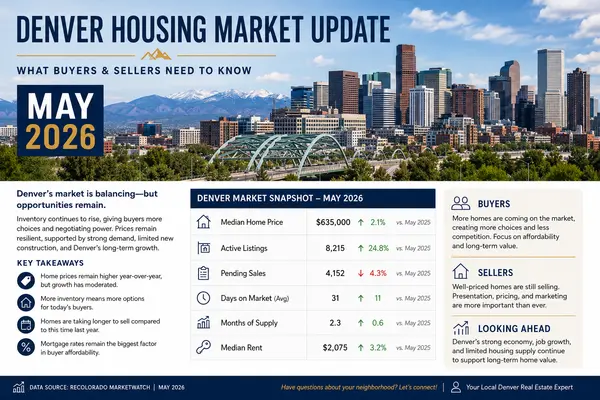
Inventory is finally giving buyers room to be selective. The Colorado Association of Realtors reported the seven-county Denver metro had about 13,400 active listings entering spring 2026 — roughly 23% more than a year earlier — with around 3.2 months of supply. More listings means more chances to find one with an assumable loan attached, and more leverage to negotiate the parts of the deal that matter.
Prices have plateaued, not crashed. The metro median sale price has held remarkably flat near $575,000–$585,000 across recent quarters, per CAR and DMAR data. A stable price plus a 3% rate is a fundamentally different affordability picture than a stable price plus a 6.5% rate.
Put simply: the conditions that make an assumable loan valuable — a wide rate gap and a market with choices — are both present in Denver right now.
The catch nobody mentions: the equity gap
Here's the part that separates buyers who pull this off from buyers who get frustrated.
When you assume a loan, you only take over the remaining balance — not the full purchase price. The difference between what the home sells for and what's left on the loan is called the equity gap, and the buyer has to cover it.
A Denver example:
A home is priced at $500,000. The seller has an assumable FHA loan with a $320,000 balance at 2.875%. The buyer assumes the $320,000 loan — but still owes the seller $180,000 in equity.
That $180,000 has to come from somewhere: cash, a second loan, or a combination. On homes that have appreciated a lot since the original loan was written, the gap can be larger than a conventional down payment, which is why these deals reward planning.
How the blended-rate math can still win
A second loan to cover the gap will carry today's higher rates — but the blended rate across both loans often still beats a single new mortgage. A simplified version of the example above:
- Assume $320,000 at 2.875%
- Cover part of the gap with $80,000 cash down
- Finance the remaining $100,000 with a second loan at, say, 8%
Your blended rate works out to roughly 4.1% across the financed amount — well under a new 6.5% first mortgage. Over the life of the loan, that spread can mean tens of thousands of dollars in interest saved.
The takeaway isn't that the math always works — it depends on the balance, the gap, and what gap financing costs you. It's that you can't judge an assumption by the headline rate alone. Run the blended number before you decide. (Happy to do that math with you on any specific listing.)
How to actually find assumable homes in Denver
This is the hard part, and it's why these opportunities stay hidden:
- The MLS usually won't tell you. Loan type is rarely listed, so a home with a 2.875% assumable loan can look identical to every other listing. You — or your agent — generally have to ask the listing agent directly whether the loan is FHA, VA, or USDA.
- The seller has to initiate. Federal privacy rules mean a buyer can't call the seller's loan servicer to ask about the loan. The request has to start on the seller's side.
- A handful of national databases now track assumable listings by loan type, which can be a starting point — but local knowledge of which Denver sellers are sitting on low-rate government loans is where an experienced agent earns their keep.
The process and timeline (set expectations early)
Assumptions take longer than a standard purchase, so the contract has to be written for it:
- You still have to qualify. The seller's servicer underwrites you much like a new loan — credit, income, employment, and assets — under FHA or VA standards.
- Timelines run long. Servicer processing commonly takes 45 to 120 days, far longer than a conventional close. Some servicers are much slower than others.
- Closing costs are often lower. Assumption fees typically run a few hundred to about $1,500, plus standard title and closing charges — and FHA/VA assumptions often waive the appraisal. VA assumptions carry a 0.5% funding fee.
- Sellers need a release of liability, especially on VA loans, so they aren't left responsible for a loan they no longer benefit from. VA sellers also need to understand how their entitlement is affected.
A note for sellers: this is a marketing edge most agents ignore
If you bought your Denver-area home between 2020 and 2022 with an FHA or VA loan, your low rate may be one of the most valuable features of your listing — and one industry estimate suggests the vast majority of eligible sellers don't even know it.
In a market where buyers are negotiating harder and watching every dollar of their monthly payment, "assumable 2.875% loan" in the listing can be the line that gets your home to the top of a buyer's list. It's the kind of detail that widens your buyer pool exactly when more inventory means more competition for attention.
Frequently asked questions
Can I assume any home's mortgage in Denver? No. Only government-backed loans — FHA, VA, and USDA — are routinely assumable. Conventional loans backed by Fannie Mae or Freddie Mac generally can't be assumed because of the due-on-sale clause.
Do I need to be a veteran to assume a VA loan? No. A non-veteran can assume a VA loan if they qualify with the servicer. But the seller's VA entitlement may stay tied to the loan unless the buyer is an eligible veteran using a substitution of entitlement — an important point for sellers.
How much cash do I need for an assumable mortgage? Enough to cover the equity gap — the difference between the purchase price and the remaining loan balance — through cash, a second loan, or both. On an appreciated Denver home, that gap can be larger than a typical down payment, so plan ahead.
Is assuming a mortgage cheaper than a new loan? Often, yes, when the assumed rate is well below market. Even after financing the equity gap at today's rates, the blended rate frequently lands below a new 6.5% mortgage. The only way to know for sure is to run the numbers on the specific loan.
How long does an assumption take to close? Typically 45 to 120 days, depending on the servicer — meaningfully longer than a standard purchase, so the timeline needs to be built into the contract.
Thinking about a low-rate assumption in the Denver metro?
Whether you're a buyer trying to find these hidden listings or a seller with a sub-4% loan worth advertising, the details matter — loan type, the equity gap, the blended math, and the servicer timeline. If you'd like help running the numbers on a specific home or finding assumable listings around Denver and Aurora, reach out to Jordan for a personalized look.
Categories
Recent Posts






"My job is to find and attract mastery-based agents to the office, protect the culture, and make sure everyone is happy! "